Customize Your Pot
Please Note: Size & position of custom text may vary slightly. Please allow an additional 1-2 days for processing your order.


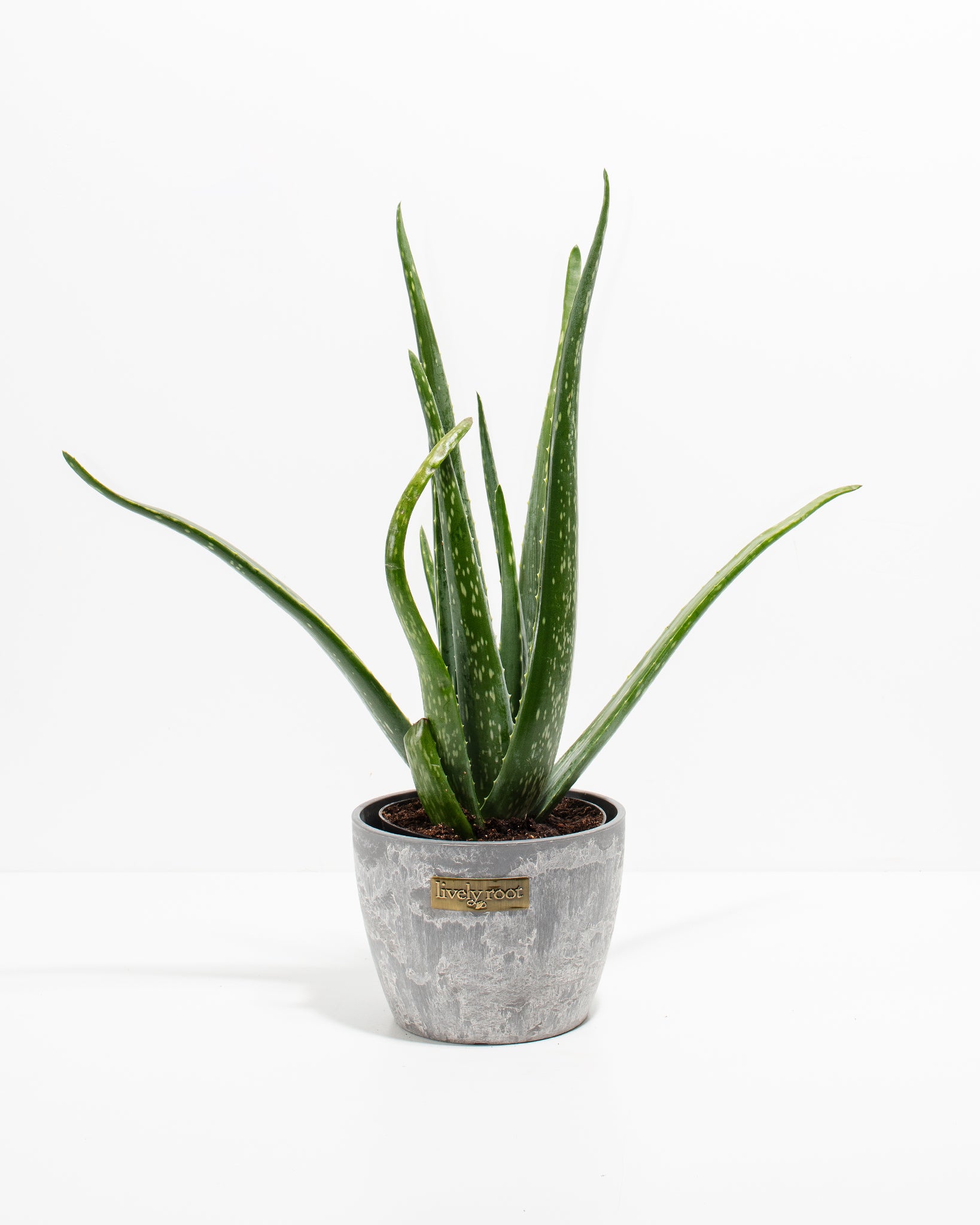
The aloe vera plant (Barbados Aloe) is notorious for being one of the most sought-after succulents worldwide. Its medicinal properties have made it a popular ingredient for various beauty and health products. The Aloe's succulent leaves contain rich antioxidant and antibacterial properties in their extract. Bonus—it is a very low-maintenance plant to have in your collection!

Indoors: Bright, indirect light in a southern or western exposure window. Outdoors: Set in bright indirect light or 2-4 hours of morning sun and afternoon shade where temperatures are above 45°F at night.
Water your Aloe vera when the soil is dry on your moisture meter. Check the moisture every two weeks in the summer and every four weeks in the winter. Use filtered, bottled, or tap water that has been sitting 24 hours to release the chemicals. Take the plant out of your decorative container and water enough to discharge out of the drainage holes. Allow the plant to absorb the excess water for 15 minutes in a tray and then remove the excess water and allow them to finish draining. Once the water is fully drained, replace it into the cache or decorative pot. Allow your Aloe Vera plant to dry out between waterings and rotate your plant one quarter turn each time you water for consistent indirect sunlight exposure.
The Aloe vera plant doesn't need any extra humidity.
Average comfortable room temperatures will be sufficient. These plants do not like cold termperatures under 45°F.
This Aloe plant can thrive in full sun for at least 6-8 hours per day or a brightly covered area where temperatures are above 45°F at night.
Your Aloe vera is very self-sufficient. If you must, once a year in the spring, fertilize it with a balanced indoor plant fertilizer at half strength.
When receiving the Aloe vera, do not repot immediately but wait at least 6-12 months. Repot every two to three years or when the roots are beginning to get crowded and growing through the drainage holes.
Repot in the spring, using a 2 inches bigger pot with drainage holes to keep the roots drier.
Place a piece of screening at the bottom of the container over the drainage hole to secure the soil and allow it to drain. Use cacti and succulent potting mix or an aerated soil mixture to prevent any root rot in this indoor plant.
Add the soil mix to the bottom to elevate the root ball. Lift the plant and release the roots against the existing planter. Use a clean knife or garden trowel to wedge between the pot and the soil to loosen.
Inspect the root ball. Notice if there are any dead or rotting roots and trim off with sterile pruners. If the plant is rootbound, cut through the roots to alleviate continued encircling.
Ensure the plant is sitting about 1 inch below the edge of the pot to avoid water spillage. Add more soil and backfill around the sides by tamping down. Fill up to the soil line but not over.
Water thoroughly, and let the pot drain. If settling occurs, add more soil.
With a sterilized knife or pruners, you can cut off spent flower stalks at the base of the stem to groom the plant if being grown outside. To harvest a leaf for medicinal purposes or cleaning, cut the leaf at the bottom of the plant nearest to the main branch.
Remove offshoots from the Aloe vera plant to start a new plant. The offsets are attached to the mother plant below the soil's surface. Remove the soil down to where they're connected. Then, separate them with scissors or a sterilized sharp knife. Leave a little piece of the stem on the new Aloe. Sit these new offsets out in the air for several days to callous over the wound. This action will help prevent root rot when repotting. Keep them in a warm, dry place out of direct sunlight while they heal over. Next, pot them in a cactus and succulent potting mix to help with aeration and drainage. Put in an indirect, brightly lit spot on the southern or eastern exposure of your home. Wait a week before watering your newly potted offshoots.
Aloe vera (Aloe barbadensis), is a succulent you can care for as a houseplant or outdoor plant, depending on your climate. It belongs to the Asphodelaceae family and the Aloe genus and has thick, fleshy green leaves and stems with a distinctive look. The leaves are star-like and orientated in all directions. They also have little thorn-like spikes along the edges.
Before you purchase your Aloe Vera plant, note that you’ll need to provide it with bright, indirect sunlight. These tropical beauties also thrive in well-draining soil and require minimal watering, especially during winter, making them an easy-to-care-for option for your home. If you fulfill all the basic needs of your aloe plant, it could thrive indoors for over 20 years. However, most tend to live to around the ten-year mark.
Aloe vera is a medicinal plant with antioxidant and antibacterial properties. It has several benefits, including:
Now, let’s delve into aloe vera care's simple yet rewarding journey.
Water aloe vera plants deeply but infrequently. In other words, the soil should feel moist after watering, but it should be allowed to dry out to some extent in between. Generally speaking, you should plan to water your aloe plant every 2-3 weeks in the spring and summer and even more sparingly during the fall and winter.
Place your aloe in bright, indirect sunlight. A western or southern window is ideal for this drought-tolerant plant. If you keep it in low light, it will tend to grow leggy.
Aloe vera thrives in temperatures between 55°F and 80°F, making it ideal as a houseplant. You can also keep your plant outdoors in warm, hardy zones. However, remember to bring it back inside if the evenings and nights are cold.
Your Aloe can handle dry air just fine and doesn’t require extra humidity. 40% relative humidity is perfect.
In its natural habitat, aloe commonly grows in nutrient-poor soil conditions on sandy slopes with guaranteed drainage. So, use a cactus potting medium or traditional potting soil mixed with perlite and coarse sand. Repot your aloe when it becomes rootbound or if its pups seem overcrowded.
You don’t need to fertilize an aloe because it's adapted to nutritionally poor desert soil. However, you could feed your potted aloe once a year in the spring to help it maintain vibrant growth.
Propagation is best done by replanting offsets (the pups) that develop at the base of the plant. Separate them from the mother plant using pruning shears or a sharp knife. Before potting them, leave the pups sitting for several days to allow them to form a callous over the cut. Then, pot them in a well-draining, standard succulent potting mix and put them in a sunny location.
Only prune your aloe if the leaves are shriveled and dead. Use clean garden shears, cut the affected tip, or prune the entire leaf at its base. Pruning will encourage new growth and make the plant more aesthetically pleasing.
Your aloe could be affected by aloe scales, mites, and mealybugs. After spraying the plant with water, you can wipe away mealybugs with a soft cloth. Scales can be eradicated with a solution of insecticidal soap, isopropyl alcohol, and water. If mites are the issue, prune any infected tissue.
When humidity is high and temperatures are cool, aloe rust, a fungal disease, can also be a problem. It presents as yellow spots on the leaves, eventually expanding and turning into yellow spots on the leaves, eventually expanding and turning brown. This disease is self-limiting and usually doesn’t require treatment.
This next section will navigate you through optimal placement, ideal companions, and alternative options for aloe plants.
Enhance the beauty of your aloe with these companions:
Explore some pet-friendly alternatives to aloe:
Explore our aloe vera plants for sale and add a touch of natural beauty to your succulent collection. Elevate your space with these versatile plants' soothing and aesthetic appeal.